Tuesday, September 24, 2013

Pope Francis' interview (part 1)

Here are 10 important points that came out of Pope Francis’ interview printed in various Jesuit magazines and journals last week. The interview was conducted in August by Fr Antonio Spadaro, SJ. Here are the first 5 points, with the other 5 appearing in tomorrow’s post.

His living quarters
- "I chose to live [in Santa Marta], in Room 201, because when I took possession of the papal apartment, inside myself I distinctly heard a ‘no.’ The papal apartment in the Apostolic Palace is not luxurious. It is old, tastefully decorated and large, but not luxurious. It is big and spacious, but the entrance is really tight. People can come only in dribs and drabs, and I cannot live without people. I need to live my life with others.”

On Pope Benedict’s resignation
- "Pope Benedict has done an act of holiness, greatness, humility. He is a man of God."

Healing without being legalistic - "I see clearly that the thing the church needs most today is the ability to heal wounds and to warm the hearts of the faithful; it needs nearness, proximity. I see the church as a field hospital after battle. The church sometimes has locked itself up in small things, in small-minded rules."

Fr Antonio Spadaro SJ during the interview with Pope Francis
Merciful, not rigorous - "And the ministers of the church must be ministers of mercy above all. The confessor, for example, is always in danger of being either too much of a rigorist or too lax. Neither is merciful, because neither of them really takes responsibility for the person. The rigorist washes his hands so that he leaves it to the commandment. The loose minister washes his hands by simply saying, ‘This is not a sin’ or something like that. In pastoral ministry we must accompany people, and we must heal their wounds."

On respecting homosexuals - "A person once asked me, in a provocative manner, if I approved of homosexuality. I replied with another question: ‘Tell me: when God looks at a gay person, does he endorse the existence of this person with love, or reject and condemn this person?’ We must always consider the person. Here we enter into the mystery of the human being. In life, God accompanies persons, and we must accompany them, starting from their situation. It is necessary to accompany them with mercy. When that happens, the Holy Spirit inspires the priest to say the right thing."

Monday, September 23, 2013

Saint Pio of Pietralcina

In Assisi, by the frescoes of St Clare and St Francis
This is one of my favorite prayers by St Pio of Pietralcina, (1887-1968) whose liturgical feast we celebrate today:
My dear Jesus, release from my mind and heart 
- any troubles from the past, 
- any worries about the present, 
- any anxieties about the future. 
So that I can desire always, and in everything, just one thing 
– TO GO AGAINST MYSELF IN FAVOR OF YOUR LOVE. 
I entrust my reckless and troubled past to Your bountiful Mercy, o Lord. I also entrust to Your infinite Love my confused and undecided present. And I entrust to Your holy Providence my mysterious future. Amen.
A rare photo of St Pio of Pietralcina hearing confessions

Sunday, September 22, 2013

Prayer at Ground Zero

The improvised cross at Ground Zero on 9-11-01
This touching prayer was offered at Ground Zero in New York City by Pope Emeritus Benedict XVI on April 20, 2008. I share it with you today so that we will not forget the pain and suffering that so many people experienced 12 years ago, and when the nation was united  like never before:
O God of love, compassion, and healing,  look on us, people of many different faiths and traditions, who gather today at this site, the scene of incredible violence and pain. We ask you in your goodness to give eternal light and peace to all who died here—the heroic first-responders: our fire fighters, police officers, emergency service workers, and Port Authority personnel, along with all the innocent men and women who were victims of this tragedy simply because their work or service brought them here on September 11, 2001.

We ask you, in your compassion to bring healing to those who, because of their presence here that day, suffer from injuries and illness.  Heal, too, the pain of still-grieving families and all who lost loved ones in this tragedy. Give them strength to continue their lives with courage and hope. We are mindful as well of those who suffered death, injury, and loss on the same day at the Pentagon and in Shanksville, Pennsylvania. Our hearts are one with theirs as our prayer embraces their pain and suffering. God of peace, bring your peace to our violent world: peace in the hearts of all men and women and peace among the nations of the earth. Turn to your way of love those whose hearts and minds are consumed with hatred. God of understanding, overwhelmed by the magnitude of this tragedy, we seek your light and guidance as we confront such terrible events. Grant that those whose lives were spared may live so that the lives lost here may not have been lost in vain. Comfort and console us, strengthen us in hope, and give us the wisdom and courage  to work tirelessly for a world where true peace and love reign among nations and in the hearts of all.

Saturday, September 21, 2013

St Matthew and Pope Francis

Caravaggio - "The Calling of St Matthew"

The stunning interview that Pope Francis gave to La Civilta Cattolica has been the talk of the town, or of the world this week. I will share a few lines from it later on, but today I refer to the reference Pope Francis made to St Matthew, whose feast we celebrate today. In the course of the interview, the Pope says: “I do not know Rome well. I know a few things. These include the Basilica of St. Mary Major; I always used to go there. I know St. Mary Major, St. Peter’s...but when I had to come to Rome, I always stayed in Via della Scrofa. From there I often visited the Church of St. Louis of France, and I went there to contemplate the painting of ‘The Calling of St. Matthew,’ by Caravaggio.
Detail from Caravaggio's "The Calling of St Matthew"
"That finger of Jesus, pointing at Matthew. That’s me. I feel like him. Like Matthew. It is the gesture of Matthew that strikes me: he holds on to his money as if to say, ‘No, not me! No, this money is mine.’ Here, this is me, a sinner on whom the Lord has turned his gaze. And this is what I said when they asked me if I would accept my election as pontiff.” Then the Pope whispers in Latin: “I am a sinner, but I trust in the infinite mercy and patience of our Lord Jesus Christ, and I accept in a spirit of penance.”

Friday, September 20, 2013

The Korean Martyrs

Some of the Korean martyrs over the past 300 years, canonized in 1984

We honor today the men and women who were slain because they refused to deny Christ in the nation of Korea. The faith was brought to Korea in a unique fashion. The intellectuals of that land, eager to learn about the world, discovered some Christian books procured through Korea’s embassy to the Chinese capital. One Korean, Ni-seung-houn, went to Beijing in 1784 to study Catholicism and was baptized Peter Ri. Returning to Korea, he converted many others. In 1791, when these Christians were suddenly viewed as foreign traitors, two of Peter Ri’s converts, named Paul and Jacques, were martyred. 

The faith endured, however, and when Father James Tsiou, a Chinese, entered Korea three years later, he was greeted by four thousand Catholics. Father Tsiou worked in Korea until 1801 when he was slain by authorities. Three decades later the Prefecture Apostolic of Korea was established by Pope Leo XII, after he received a letter smuggled out of Korea by faithful Catholics. In 1836, Monsignor Lawrence Imbert managed to enter Korea. Others arrived, and they worked until 1839, when a full persecution started, bringing about the martyrdom of the European priests. Young Korean seminarians were sent to Macau for ordination. 


The first native priest, Andrew Kim Taegon, returned to Korea in 1845 and was martyred the following year. Severe persecution followed, and Catholics fled to the mountains, still spreading the faith. In 1864, a new persecution claimed the lives of two bishops, six French missionaries, another Korean priest, and eight thousand Korean Catholics. The Korean martyrs of 1839, 1846, and 1867 were canonized in Korea in 1984 by Pope John Paul II. During that ceremony, the Pope said: “The Korean Church is unique because it was founded entirely by lay people. This fledgling Church, so young and yet so strong in faith, withstood wave after wave of fierce persecution. Thus, in less than a century, it could boast of 10,000 martyrs. The death of these martyrs became the leaven of the Church and led to today's splendid flowering of the Church in Korea.”

Thursday, September 19, 2013

Saint Januarius

Martyrdom of St Januarius

St. Januarius was born in Italy and was bishop of Benevento during the Emperor Diocletian’s persecutions, who was one of the most ruthless Emperors. Bishop Januarius went to visit two deacons and two laymen in prison. He was then also imprisoned along with them. They were thrown to the wild beasts, but when the animals did not attack them, they were beheaded. What is believed to be Januarius' blood is kept in the Cathedral of Naples, as a relic. It liquifies and bubbles miraculously when exposed in the Cathedral. St Januarius died in 305 A.D.
A dark mass that half fills a hermetically sealed four-inch glass container, is preserved in a double reliquary and liquifies 3 times during a year. Tradition connects it with a certain Eusebia, who had allegedly collected the blood after the martyrdom. The ceremony accompanying the liquefaction is performed by holding the reliquary close to the altar on which is located what is believed to be the martyr's head. While the people pray, often tumultuously, the Bishop turns the reliquary up and down in the full sight of the onlookers until the liquefaction takes place. This has been going on for the past 600 years. Various experiments have been applied, but the phenomenon eludes natural explanation. Similar miraculous claims were made for the blood of John the Baptist, Stephen, Nicholas of Tolentino and Aloysius Gonzaga — nearly all in the neighborhood of Naples


Cardinal of Naples showing liquified blood of St Januarius
Many residents of Naples believe that if the saint’s blood does not turn to liquid form, it is a sign that some tragedy will befall the city. The miracle did not occur in 1980, and an earthquake south of Naples caused over 2,500 deaths. In the most distant past, the absence of the regular miracle was associated with military losses, volcanic eruptions, and outbreaks of the plague. The important thing to realize and believe is that there is something even more special that turns into blood – the consecrated wine during Mass that becomes the Blood of Christ, just as the bread turns into the real Body of Christ.

Wednesday, September 18, 2013

Religious Education

Religious Ed children and teachers (click to enlarge)

As happens in many parishes, during September the Religious Education of children starts in many parishes around the world. I remember attending classes myself every day, besides the regular one hour morning religion class in school, since all schools are Catholic. Thanks to our Religious Ed coordinator and many volunteer teachers, we run this program here at the Cathedral parish, with classes starting today. The first day is usually introductory - teachers getting to know their students, and students getting to know their teachers and other students, even though most of them are in the same class in their own public school. Next week I will celebrate Mass for all the children, their teachers and their parents, as well as other parishioners whom I invite to join us to support our program. I always emphasize the fact that the foundation of their faith is set at home, and we can only build on what parents do at home. We pray today for a successful journey for our children as they learn more about their faith. The above photo shows our children with their teachers, gathered in the Cathedral after I led the Stations of the Cross during Lent a year ago.

Tuesday, September 17, 2013

St Robert Bellarmine

St Robert Bellarmine (1542-1621)
 Born at Montepulciano, Italy, October 4, 1542, St. Robert Bellarmine was the third of ten children. His mother, Cinzia Cervini, a niece of Pope Marcellus II, was dedicated to almsgiving, prayer, meditation, fasting, and mortification of the body.

Robert entered the newly formed Society of Jesus in 1560 and after his ordination went on to teach at Louvain (1570-1576) where he became famous for his Latin sermons. In 1576, he was appointed to the chair of controversial theology at the Roman College, becoming Rector in 1592; he went on to become Provincial of Naples in 1594 and Cardinal in 1598. This outstanding scholar and devoted servant of God defended the Apostolic See against the anti-clericals in Venice and against the political tenets of James I of England. He composed an exhaustive apologetic work against the prevailing heretics of his day. In the field of church-state relations, he was also very effective in a time of major upheaval all over Europe. Remember that these were the days of the Protestant Reformation, with various leaders starting their own religion, King Henry VIII and the Anglican/Episcopalian religion, Luther with Lutheranism, Calvin and Zwingli in central Europe, and others. And like other well-know priest saints of this era, Robert was able to defend the church with the likes of St Vincent de Paul, St Ignatius of Loyola, St Francis Xavier, St Julian Peter Eymard, St Francis De Sales, St John Baptist Vianney, St Charles Borromeo and many others.

Robert Bellarmine was the spiritual father of St. Aloysius Gonzaga, a Jesuit novice, and also helped St. Francis de Sales obtain formal approval of the Visitation Order, the female order founded by St Jane Frances de Chantal. He has left us a host of important writings, including works of devotion and instruction, as well as controversy. He died in 1621 and was canonized by Pope Pius XI in 1930; the following year he was declared a Doctor of the Church. His remains, in a cardinal's red robes, are displayed behind glass under a side altar in the Church of Saint Ignatius, the chapel of the Roman College, next to the body of his student, St. Aloysius Gonzaga, as he himself had wished.

Monday, September 16, 2013

My childhood years

Team mascot/ball-boy in 1957

Back in the 1950s, I was introduced to soccer, or what we call in Malta, football. Even though everyone played football, it was only in the 1960s that I played some real football, and especially in my Seminary years in the early 1970s. But as a child I was chosen as a ball-boy for the local St Julian’s Catholic Action soccer team. I was actually called the ‘mascot’ and my job was simply to carry the ball, pose for a team photo, and then sit down and watch the game. 
St Julian's Catholic Action team in 1957

I was very honored and proud to be chosen as the team’s mascot, especially since half of the team were relatives, among them two uncles and two cousins. The team was pretty successful and many of the players became regular players on other well-known teams. There was a sense of camaraderie among all the players and other members of the Catholic Action club that met for regular meetings, religious talks, hikes, special Masses and the annual celebration in honor of Saint Anthony, our patron saint. This was even enhanced by the presence of our spiritual director and chaplain, Fr Anton Xiberras, who dedicated his life to these young people.

Sunday, September 15, 2013

Baker City sunrise

Sometimes a picture is worth a thousand words. 
Then again, sometimes, it is priceless, 
as is this picture I took yesterday of 
a Baker City sunrise.

Saturday, September 14, 2013

The Exaltation of the Cross

Icon of the Finding of the cross by St Helen

Early in the fourth century St. Helena, mother of the Roman Emperor Constantine, went to Jerusalem in search of the holy places of Christ's life. She razed the second-century Temple of Aphrodite, which tradition held was built over the Savior's tomb, and her son built the Basilica of the Holy Sepulcher over the tomb. During the excavation, workers found three crosses. Legend has it that the one on which Jesus died was identified when its touch healed a dying woman.
The cross immediately became an object of veneration. At a Good Friday celebration in Jerusalem toward the end of the fourth century, according to an eyewitness, the wood was taken out of its silver container and placed on a table together with the inscription Pilate ordered placed above Jesus' head: Then "all the people pass through one by one; all of them bow down, touching the cross and the inscription, first with their foreheads, then with their eyes; and, after kissing the cross, they move on."
To this day the Eastern Churches, Catholic and Orthodox alike, celebrate the Exaltation of the Holy Cross on the September anniversary of the basilica's dedication. The feast entered the Western calendar in the seventh century after Emperor Heraclius recovered the cross from the Persians, who had carried it off in 614, 15 years earlier. According to the story, the emperor intended to carry the cross back into Jerusalem himself, but was unable to move forward until he took off his imperial garb and became a barefoot pilgrim.

The cross is today the universal image of Christian belief. Countless generations of artists have turned it into a thing of beauty to be carried in procession or worn as jewelry. To the eyes of the first Christians, it had no beauty. It stood outside too many city walls, decorated only with decaying corpses, as a threat to anyone who defied Rome's authority—including Christians who refused sacrifice to Roman gods. We adore o Christ and we praise You, because by Your Holy Cross, You have redeemed the world.

Friday, September 13, 2013

Saint John Chrysostom

St John Chrysostom (349-407 AD)

Saint John Chrysostom was born in Antioch about the year 349. After an extensive education he embraced a life of asceticism. He was ordained a priest and distinguished himself by his preaching which achieved great spiritual results among his hearers.  He was elected Bishop of Constantinople in 397 and proved himself a capable pastor, committed to reforming the life of the clergy and the faithful. Twice he was forced into exile by the hatred of the imperial court and the envy of his enemies. After he had completed his difficult labors, he died in Pontus on September 14, 407. His preaching and writing explained Catholic doctrine and presented the ideal Christian life. For this reason he was called Chrysostom, meaning Golden Mouth.
From one of his homilies: “The waters have risen and severe storms are upon us, but we do not fear drowning, for we stand firmly upon a rock. Let the sea rage, it cannot break the rock. Let the waves rise, they cannot sink the boat of Jesus. What are we to fear? Death? Life to me means Christ, and death is gain. Are we to fear exile? The earth and its fullness belong to the Lord. Are we to fear the confiscation of our goods? We brought nothing into the world, and we shall surely take nothing from it. I have only contempt for the world’s threats, I find its blessings laughable. I have no fear of poverty, nor desire for wealth. I am not afraid of death nor do I long to live, except for your good. I concentrate therefore on the present situation and I urge you, my friends, to have confidence.” (From the Office of Readings)

Thursday, September 12, 2013

Holy Name of Mary

It’s hard to imagine that the Blessed Mother has many more feasts than Jesus himself in the Liturgical calendar. In one week between September 8 and 15, there are three celebrations honoring Mary. September 8 is the Nativity of Mary, September 15 is the feast of Our Lady of Sorrows, and today we celebrate the feast of the Holy Name of Mary, a feast only recently introduced, even though this was made officially a universal feast by Blessed Pope Innocent XI to commemorate victory over the Turks at the Battle of Vienna in 1683.
The feast was only a local one at its inception in 1513, when it was instituted in Cuenca, Spain. It was initially celebrated on September 15th and later on the 17th. Pope Gregory XV extended the celebration to the Archdiocese of Toledo in 1622. In 1666 the Discalced Carmelites received the faculty to recite the Office of the Name of Mary four times a year. In 1671 the feast was extended to the whole of Spain. After the victory of the Christians, lead by King John III Sobieski of Poland, over the Turks in the Battle of Vienna in 1683, the feast was extended to the whole Church by Pope Innocent XI, and assigned to the Sunday after the Nativity of Mary. Before the battle King John had placed his troops under the protection of the BVM. 


In Latin "Sacred Holy Name of Mary"
Even in the past 60 years, there has been some controversy over the date of this festivity. In 1954, it was re-instated at September 12, but was removed temporarily as many thought it was duplication of the Nativity of Mary, but in 2001, the feast of the Holy Name of Mary was once again set to be celebrated today.
Mary is Mariam or in the Holy Land. The Hebrew variant of the name is Miriam. The name may have originated in the Egyptian Meri-Amun, "beloved of the God". It was incorporated in the Exodus narrative as Miriam, the name of Moses' sister. It became common in ancient Israel, hence its appearance in the gospel narrative as the name of Jesus' mother and several other women. The name is very common among Arabs, Iranians and other Muslim cultures.
However, Mary is called by an innumerable number of names that denote a connection with something special, Our Lady of Lourdes, Fatima, Queen of Peace, Angels, Perpetual Help, Our lady of Snows, even Our Lady of Baker City.

Wednesday, September 11, 2013

The Twin Towers

An image I designed after 9-11-01

We saw them disappear 12 years in a ruthless terrorist attack. But the Twin Towers live on in my memory, as I see the Two Spiritual Towers take their place. The image of Jesus and Mary have replaced the two landmark skyscrapers that disappeared for the iconic New York skyline forever. The metal and beams and glass are gone, but the spirit of what they represented will live on in the spirit of the people, as well as the 3,000 who lost their lives that day 12 years ago.  Let us pray and remember.

“When damaged, those buildings eventually plummeted to the ground, imploding in a moment's time. Yet underneath the debris is a foundation that was not destroyed. We have a choice, whether to implode and disintegrate emotionally and spiritually as a people and a nation, or to become stronger through all of this struggle to rebuild on a solid foundation. And I believe that we're in the process of starting to rebuild on that foundation. That foundation is our trust in God. And in that faith we have the strength to endure something as difficult and horrendous as what we have experienced this week.”- Rev Billy Graham

Tuesday, September 10, 2013

Mount Hood


Last week I was able to visit Mount Hood, the highest mountain in the state of Oregon. As you can see, it still had snow, in early September - it is practically snow-capped all year round. I was lucky enough that there were no clouds when I arrived close to it, but cumulus clouds soon rolled in and it was a cloudy day from then on. 
Mount Hood as seen from Trillium Lake

One of the best places to see Mount Hood is at Trillium Lake, with a beautiful reflection of this landmark, which along with Crater Lake and the John Day Fossil Beds (which I highlighted a few days ago) are probably the three most conspicuous landmarks of Oregon.
Thanks to all those visiting my blog - this is the 600th post, and we just passed the 60,000 clicks/visitors. Please check past posts as there is always something inspirational you may have missed. Simply click on the dates and months listed in blue on the right hand side.

Monday, September 9, 2013

Vatican Vigil on Syria

St Peter's square during the Vigil for Syria held on Saturday

Tens of thousands of people filled St. Peter's Square for a four-hour Syria peace vigil late Saturday, answering Pope Francis' call for a cry for peace that was echoed by Christians and non-Christians alike in Syria and in vigils around the world. The Vatican estimated about 100,000 took part, making it one of the largest rallies in the West against proposed U.S.-led military action against the Syrian regime following the Aug. 21 chemical weapons attack near Damascus.
A section of the crowd during the Vigil for Syria
Pope Francis spent most of the vigil in silent prayer, but during a brief speech he issued a heartfelt plea for peace, denouncing those who are "captivated by the idols of dominion and power" and destroy God's creation through war. "This evening, I ask the Lord that we Christians, and our brothers and sisters of other religions and every man and woman of good will, cry out forcefully: Violence and war are never the way to peace!" he said. "May the noise of weapons cease!" he said. "War always marks the failure of peace, it is always a defeat for humanity."
In Damascus, a few dozen Syrian Christians attended a service in the al-Zaytoun Church, joining Francis' invitation for a global participation in the day of fasting and prayer and to oppose outside military intervention in the conflict. Greek Catholic Patriarch Gregorios III presided at a similar service, saying most countries supported a political solution to the crisis in Syria and few wanted military action. "This is the start of the victory," he told the Damascus faithful. "No to war. Yes for peace." Francis announced the day of fasting and prayer Sept. 1, alarmed at the acceleration of U.S. threats to strike Syria after the chemical weapons attack. Since then, the Vatican has ramped up its peace message, summoning ambassadors for a briefing by the Holy See foreign minister. Francis appealed directly to world powers at the Group of 20 meeting in Russia, urging them this week to abandon the "futile pursuit" of a military solution in Syria and work instead for a negotiated settlement.

Sunday, September 8, 2013

My childhood priests

Dun Karm Calleja at his 60 th anniversary Mass, 2 weeks ago

We all remember our childhood days and reminisce about stories that made our younger years so vibrant and alive. My own childhood focused around the parish church, and I remember serving Masses for many of the priests, who unfortunately are leaving us one after the other. Among them is Fr Carmelo Calleja, known by everyone as Dun Karm, also a Canon of the parish church of Birkirkara. But he spent his entire 60 years serving in St. Julian’s parish. Incidentally only two weeks ago he celebrated his 60th anniversary as a priest with a Mass during the run-up of the festa dedicated to St Julian’s. He was in fact in fairly good shape, but apparently his health deteriorated suddenly and died early this week.

Dum Karm as a Canon of the Birkirkara parish
Dun Karm wore many hats, as a teacher, both in public schools as well as catechism classes. He led a children’s choir for a while, was the chaplain of women’s groups of the Catholic Action, as well as the Spinola Band Club. He was very faithful till the end saying daily Mass in the parish and helping anyone who needed an ear to listen to them. And so most of my childhood priests are gone, including Dun Anton Xiberras, Dun Fortunato Axiaq, Dun Philip Demarco, Dun Frangisk Zammit, Dun Edwin Sammut and now Dun Karm Calleja. From my childhood years in the early 60s, still Dun Guido Calleja and Dun Gwann Galea still survive, both of whom were pastors of the parish, respectively from 1956 till 1966 and from 1966 till 1981.

The above photo was taken in 1967 at an engagement party of my uncle Marcel and his fiancee Julie Saliba. Left to right are Dun Karm Calleja, Dun Fortunato Axiaq, Marcel and Julie, Dun Gwann Galea and Dun Anton Xiberras. May Dun Karm and all the other priests rest in peace.

Saturday, September 7, 2013

Prehistoric archaeology

Hill known as Sheep Rock in the John Day prehistoric area

I share with you today a few photos I took this week of some prehistoric stonework from the John Day and Kimberly area in central Oregon. The area is incredibly rich with such  terrain and archaeological remains, and is monitored by the John Day Fossil Beds National Monument, a US National Monument in Wheeler and Grant counties  in east-central Oregon. 

A section in the same area known as Cathedral Rock
Located within the John Day River basin, the park is known for its well-preserved layers of fossils and mammals that lived in the region between the late Eocene, about 44 million years ago, and the late Miocene, about 7 million years ago. The monument consists of three geographically separate units: Sheep Rock, Painted Hills, and Clarno.The entire area is characterized by hills, deep ravines, and eroded fossil-bearing rock formations, some of which you can see in these photos. Click on each photo to enlarge and admire better.

A closer look at Cathedral Rock
The very old and the very new combined in this 'timely' photo

Friday, September 6, 2013

A Prayer for Catechists

As many parishes start their Religious Education classes at this time of the year, I share with you a prayer for all catechists who will be entrusted with the care and education of our children in parishes around the country.

Lord, we thank You for calling us to be catechists. We believe you are for each of us the Way, the Truth and the Life. Help us to show our students the Way to happiness, the Way to peace and loving Respect. Help us to lead our students to be satisfied only with living sincere lives, to be honest in all their deeds, and to know that Your Truth is what matters to us.
Help us to inspire our students to live generous, other-centered lives. Lord God, we trust in Your generous love to us. With patience, peace and Your presence, help us to break open the bread of Your Word to our children. With wisdom, warmth and a willing spirit, help us to lead our children on the path of faith. With truth, tenderness and tolerance, help us to guide gently the children entrusted to our care. And with commitment, care and compassion, help us to inspire our children in following in Your footsteps ever so faithfully. Remind us always to be prepared for our classes, realizing that we have in our precious hands, the leaders of the 21st century, the parents of our future, the civil and religious leaders who will influence our world and our Church in the years to come. We ask this through Christ our Lord. AMEN

Thursday, September 5, 2013

How language changes

LIFE BEFORE THE COMPUTER

An application was for employment
A program was a TV show
A cursor used profanity
A keyboard was a piano!
Memory was something that you lost with age
A CD was a bank account
And if you had a 3 1/2 inch floppy, you hoped nobody found out!
Compress was something you did to garbage, not something you did to a file
And if you unzipped anything in public, you'd be in jail for awhile!
Log on was adding wood to a fire
Hard drive was a long trip on the road
A mouse pad was where a mouse lived
And a backup happened to your commode!
Cut - you did with a pocket knife
Paste you did with glue
A web was a spider's home
And a virus was the flu!
I guess I'll stick to my pad and paper, and the memory in my head
I hear nobody's been killed in a computer crash, but when it happens they wish they were dead!

Wednesday, September 4, 2013

A new look English

Having chosen English as the preferred language in the EEC, the European Parliament has commissioned a feasibility study in ways of improving efficiency in communications between Government departments.
European officials have often pointed out that English spelling is unnecessarily difficult--for example, cough, plough, rough, through and thorough. What is clearly needed is a phased programme of changes to iron out these anomalies. The programme would, of course, be administered by a committee staff at top level by participating nations.
In the first year, for example, the committee would suggest using "s" instead of the soft "c." Sertainly, sivil servants in all sities would reseive this news with joy. Then the hard, "c" could be replaced by "k" sinse both letters are pronounced alike. Not only would this klear up konfusion in the minds of klerical workers, but typewriters kould be made with one less letter.
There would be growing enthusiasm in the sekond year, it kould be announsed that the troublesome "ph" would henceforth be written "f." This would make words like "fotograf" twenty per sent shorter in print.
In the third year, publik akseptance of the new spelling kan be expekted to reash the stage where more komplikated shanges are possible. Governments would enkourage the removal of double letters which have always been a deterent to akurate speling.
We would al agre that the horible mes of silent "e"s in the languag is disgrasful. Therefor we kould drop thes and kontinu to read and writ as though no thing had hapend. By this tim it would be four years sins the skem began and peopl would be reseptiv to steps sutsh as replasing "th" by "z."
Perhaps zen ze funktion of "u" kould be taken on by "v", vitsh is, after al, half a "w." Shortly after zis, ze unesesary "o" kuld be droped from words kontaining "ou." Similar arguments vud of kors be aplid to ozer kombinations of leters.
Kontinuing zis proses yer after yer, ve vud eventull hav a reli sensibl riten styl, after twenti yers zer vud be no mor trubls, difikultis and evrivun vud fin it ezi tu understand ech ozer. Ze drems of ze Guvermnt vud finali hav kum tru.

Tuesday, September 3, 2013

Humility prayer of a person getting older


Lord, you know better than myself that I am growing older and will soon be old. Keep me from becoming too talkative, and especially from the unfortunate habit of thinking that I must say something on every subject and at every opportunity.
Release me from the idea that I must straighten out other peoples' affairs. With my immense treasure of experience and wisdom, it seems a pity not to let everybody partake of it. But you know, Lord, that in the end I will need a few friends. Keep me from the recital of endless details; give me wings to get to the point.
Grant me the patience to listen to the complaints of others; help me to endure them with charity. But seal my lips on my own aches and pains - they increase with the increasing years and my inclination to recount them is also increasing.


I will not ask you for improved memory, but only for a little more humility and less self-assurance when my own memory doesn't agree with that of others. Teach me the glorious lesson that occasionally I may be wrong.
Keep me reasonably gentle. I do not have the ambition to become a saint - it is so hard to live with some of them - but a harsh old person is one of the devil's masterpieces.
Make me sympathetic without being sentimental, helpful but not bossy. Let me discover merits where I had not expected them, and talents in people whom I had not thought to possess any. And, Lord, give me the grace to tell them so.

Monday, September 2, 2013

Honoring Labor Day

Norman Rockwell - Anvil workers

In honor of Labor Day, today I share with you two posters that Norman Rockwell painted for the Saturday Evening Post, both of which relate to work and labor. The first one shows two men hammering on an anvil, with a variety of people looking at them and admiring their strength. The second one shows a woman posing as a riveter, a job that was popular during World War II, when women were employed to bang in hundreds of rivets on planes and other equipment. Many of them became deaf in the process, and I remember one parishioner who died recently, who was a riveter, and of course, hard of hearing. 

Norman Rockwell - Rosie the Riveter

We pray today for all those who are searching for jobs to support their families. May God provide work for everyone, and may we appreciate the opportunity to work and earn a living. And may we all give a full day's worth of work which complements our salary and pay-checks we receive. Many people may look at work as a punishment we received as a result of Adam and Eve's sin. But consider also how boring it would be if we did not have to do any work, how unproductive our lives would be, and how lazy everyone would be. By working we have the opportunity to continue God's creation, as throughout the centuries, many inventions were created, just because men and women did not remain lazy or unproductive, but used their minds and hands to work and be creative.

Sunday, September 1, 2013

Humility


The following prayer was written by Rafael Cardinal Merry del Val (1865-1930), Secretary of State for Pope Saint Pius X, and it fits perfectly for this weekend’s readings reflecting on the theme of humility.

O Jesus! meek and humble of heart, Hear me.
From the desire of being esteemed, deliver me, Jesus.
From the desire of being loved...deliver me, Jesus.
From the desire of being extolled ...
From the desire of being honored ...
From the desire of being praised ...
From the desire of being preferred to others...
From the desire of being consulted ...
From the desire of being approved ...
From the fear of being humiliated ...
From the fear of being despised...
From the fear of suffering rebukes ...
From the fear of being calumniated ...
From the fear of being forgotten ...
From the fear of being ridiculed ...
From the fear of being wronged ...
From the fear of being suspected ...

That others may be loved more than I, Jesus, grant me the grace to desire it.

That others may be esteemed more than I ...
That, in the opinion of the world,
others may increase and I may decrease ...
That others may be chosen and I set aside ...
That others may be praised and I unnoticed ...
That others may be preferred to me in everything...
That others may become holier than I, provided that I may become as holy as I should…

Saturday, August 31, 2013

Success and Failure

Winston Churchill

A young English boy was called ‘carrot top’ by other students and was given little chance by some teachers. He ranked third lowest in class and constantly failed mathematics and Latin. He repeated his grade twice and was said to have little understanding of his school work. He never gave up though, and eventually became Prime Minister of England. His name was Winston Churchill.

Elvis Presley
When Elvis Presley in 1953 tried out as a singer in the Grand Ole Opry, the main judge pulled him aside and asked him, “What do you do for a living?” And Elvis responded “I drive trucks, Sir.” To which the judge responded, “Well, I suggest that you forget about singing and keep on trucking!” The world of music is glad that Elvis did not follow the judge’s suggestion and did not give up on his singing career.

Friday, August 30, 2013

Leonardo's Genius

Da Vinci's anatomical dissection of an embryo

He may be renowned for masterpieces such as the Mona Lisa and the Last Supper, but Leonardo da Vinci is also one of the greatest anatomists the world has seen. His intricate knowledge of the human body, which was years ahead of his time, is demonstrated in a collection of notebooks which he filled with detailed studies of organs, bones, vessels and muscles using new illustrative techniques. The collection of notebooks, which date between 1452 and 1519, chart much of the Italian renaissance artist's groundbreaking studies of the human body. These notebooks are presently being exhibited in Edinburgh, Scotland until November 10. Curators say his work foreshadows modern techniques like MRI scans and 3D computer modeling 'to an astonishing degree'. Da Vinci began researching the human body to ensure his paintings were as true to nature as possible. Between 1507 and 1513 he dissected more than 30 human corpses, including that of a 100-year-old man.

Da Vinci's notes on the human hand
Leonardo da Vinci is best known for his stunning artwork but the Italian Renaissance painter had many talents. He was also a sculptor, architect, musician, mathematician, engineer, inventor, anatomist, geologist, cartographer, botanist, and writer. Only around fifteen of his paintings survive because of his constant, and frequently disastrous, experimentation with new techniques, and his chronic procrastination. Leonardo is also revered for his technological ingenuity. He conceptualised a helicopter, a tank, concentrated solar power, a calculator, and the double hull, also outlining a rudimentary theory of plate tectonics. But everyone agrees that the artist mostly known for the Mona Lisa, was a genius, way ahead of his time.

Thursday, August 29, 2013

Children's questions to Mary

A few days ago I shared with you some questions that children may want to ask Jesus. Now a few questions to His mother Mary…..
Dear Mary, did you say the prayers with Jesus when he woke up – we say our prayers even before we go to bed.
Dear Mary, did you say grace before meals and pray for those who have nothing to eat? – we pray Jesus’ favorite prayer when we say “Give us this day our daily bread.”
Dear Mary, did you have a pet dog or cat or maybe even a donkey? – we have a dog, some fish and a cockatiel who squeaks a lot.
Dear Mary, did you stay with Jesus when he was doing his homework? – did he do all his homework in time, and finish all his projects in time?
Dear Mary, did you have a Bible at home? – we have a Bible from which we read daily, and another big one with leather cover and lots of pictures in it.
Dear Mary, did you speak to the Holy Spirit? – I know you saw him at Pentecost, but did Jesus ever speak about him to you?
Dear Mary, did you ever tell Jesus about where he was born? – was he ever disappointed that he wasn’t born in a nicer place?

Dear Mary, did you ever tell him what the shepherds said about him, and what gifts the Kings gave him? – I bet he would have preferred some toys!
Dear Mary, how really worried were you when Jesus was lost for 3 days? – you must have panicked a little, as my parents do when I get lost sometimes.
Dear Mary, when Joseph died, did Jesus work for you, so that he can feed you with some income?
Dear Mary, you must have been heart-broken when you see Jesus being killed and crucified on the cross. We remember you every year as we pray to the Sorrowful Mother.
Dear Mary, what feelings went through your mind when they placed Jesus’ lifeless body on your lap when he was taken down from the Cross? We remember you as pray to you as the Pieta’.
Dear Mary, we love the prayer of the Rosary and wish more people would say it more frequently. I say it daily, along with our entire family at night before we go to sleep.

Wednesday, August 28, 2013

'I have a dream'

It was 50 years ago today that Martin Luther King delivered that impassioned speech in Washington DC, and here is an important section of the speech:

I say to you, my friends, we have the difficulties of today and tomorrow.
I still have a dream. It is a dream deeply rooted in the American dream.
I have a dream that one day this nation will rise up and live out the true meaning of its creed. We hold these truths to be self-evident that all men are created equal.
I have a dream that one day even the state of Mississippi, a state sweltering with the heat of oppression, will be transformed into an oasis of freedom and justice.
I have a dream that my four little children will one day live in a nation where they will not be judged by the color of their skin but by their character.

I have a dream today.


I have a dream that one day down in Alabama, with its vicious racists, with its governor having his lips dripping with the words of interpostion and nullification; that one day right down in Alabama little black boys and black girls will be able to join hands with little white boys and white girls as sisters and brothers.
I have a dream that one day every valley shall be engulfed, every hill shall be exalted and every mountain shall be made low, the rough places will be made plains and the crooked places will be made straight and the glory of the Lord shall be revealed and all flesh shall see it together.
This is our hope. This is the faith that I will go back to the South with. With this faith we will be able to hew out of the mountain of despair a stone of hope.
With this faith we will be able to transform the jangling discords of our nation into a beautiful symphony of brotherhood.

With this faith we will be able to work together, to pray together, to struggle together, to go to jail together, to climb up for freedom together, knowing that we will be free one day.
This will be the day when all of God's children will be able to sing with new meaning "My country 'tis of thee, sweet land of liberty, of thee I sing. Land where my father's died, land of the Pilgrim's pride, from every mountainside, let freedom ring!"
And if America is to be a great nation, this must become true. So let freedom ring from the hilltops of New Hampshire. Let freedom ring from the mighty mountains of New York.
Let freedom ring from the heightening Alleghenies of Pennsylvania.
Let freedom ring from the snow-capped Rockies of Colorado.
Let freedom ring from the curvaceous slopes of California.
But not only that, let freedom ring from Stone Mountain of Georgia.
Let freedom ring from every hill and molehill of Mississippi and every mountainside.


When we let freedom ring, when we let it ring from every tenement and every hamlet, from every state and every city, we will be able to speed up that day when all of God's children, black men and white men, Jews and Gentiles, Protestants and Catholics, will be able to join hands and sing in the words of the old spiritual, "Free at last, free at last. Thank God Almighty, we are free at last."

Tuesday, August 27, 2013

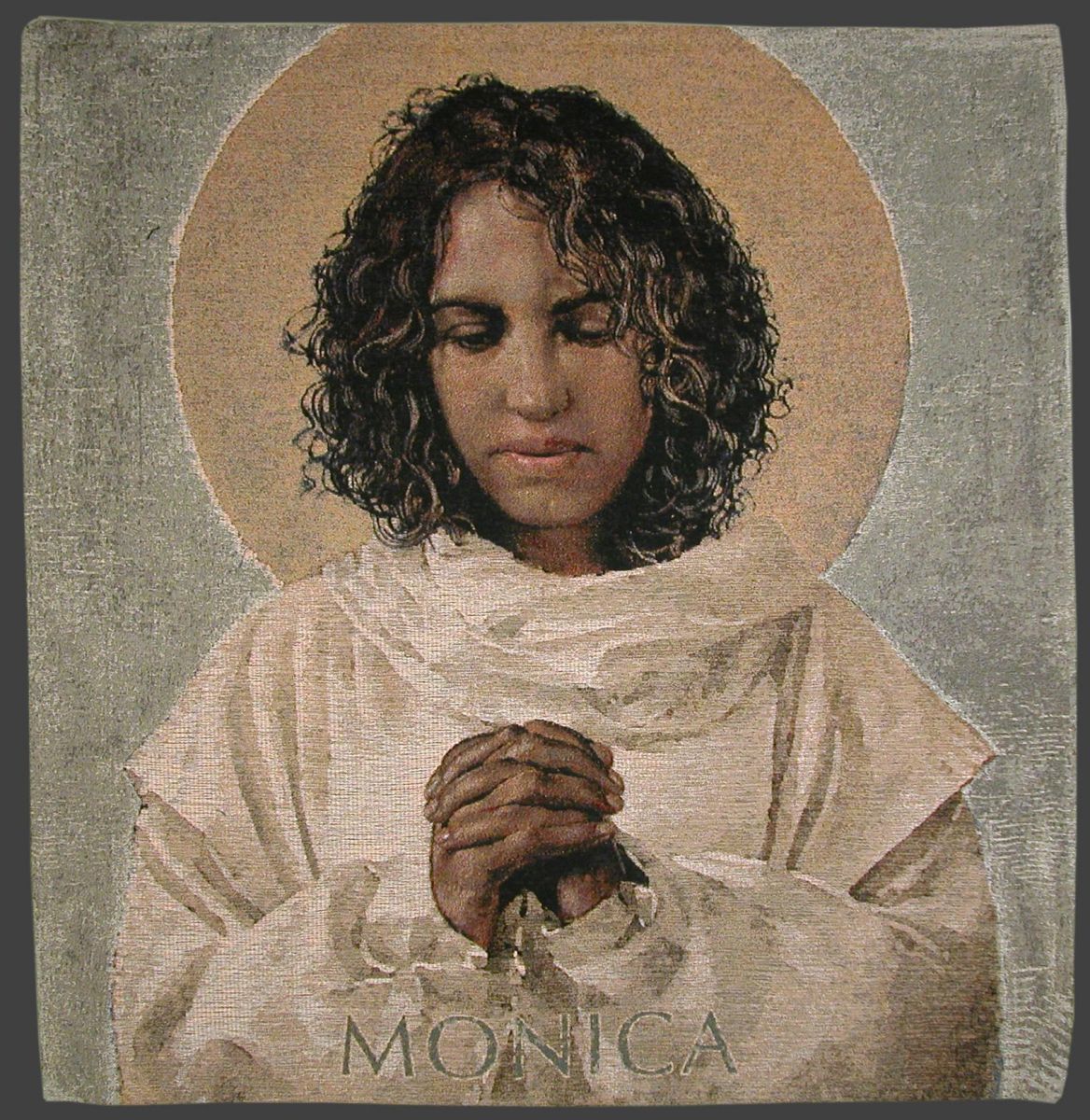
Saint Monica

Saint Monica
Any woman who spends her life praying for the conversion of her husband and her wayward son deserves to be canonized, especially after her own son becomes a popular Saint and a Doctor of the Church. Monica’s parents brought her up as Christian and married her to an older, pagan man named Patricius. He was a man with a great deal of energy, but also a man given to violent tempers and adultery. Her son St Augustine writes in one of his books that despite the prevalence of domestic abuse at the time, because of her obedience to him, Patricius never beat St. Monica. His mother lived with them and was equally difficult, which proved a constant challenge to St. Monica. However, St Monica attended church daily and cultivated the virtue of patience. She would say to other women who had bad marriages, "If you can master your tongue, not only do you run less risk of being beaten, but perhaps you may even, one day, make your husband better."

She had three children; Augustine, Navigius, and Perpetua. Through her patience and prayers, she was able to convert her husband and his mother to the Catholic faith in 370. He died a year later. Perpetua and Navigius entered the religious Life. St. Augustine was much more difficult, as she had to pray for him for 17 years, begging the prayers of priests who, for a while, tried to avoid her because of her persistence at this seemingly hopeless endeavor. One priest did console her by saying, "it is not possible that the son of so many tears should perish." This thought, coupled with a vision that she had received, strengthened her. St. Augustine was baptized by St. Ambrose in 387. Not long after, as she was preparing to return to Africa, she died at the age of 56 at the port of Ostia, Italy, telling Augustine: "There was indeed one thing for which I wished to tarry a little in this life, and that was that I might see you a Catholic Christian before I died. My God has answered this more than abundantly. What more am I to do here?" St Augustine’s feast will be celebrated tomorrow, a day after his mother’s feast.