Friday, August 24, 2012

Saint Bartholomew

St Bartholomew statue at St John Lateran, Rome

All that is known of St Bartholomew with certainty is that he is mentioned in the Gospels and Acts as one of the twelve apostles. His name means "son of Tolomai" (or Ptolemy) and scholars believe he is the same as Nathanael mentioned in John’s Gospel, who says he is from Cana and that Jesus called him an "Israelite...incapable of deceit, a person in whom there is no guile." He was a close friend of St Philip, because they are always mentioned together.
After the Ascension, Bartholomew went on a missionary tour to India. Other traditions record him as serving in Ethiopia, Mesopotamia, Persia and Egypt. Along with St Jude, Bartholomew is reputed to have brought Christianity to Armenia in the st century. Thus both saints are considered the patron saints of the Armenian Apostolic Church. However, it is in Greater Armenia that Bartholomew saw his end where he was flayed or skinned and beheaded by King Astyages. The famous Last Judgment painting by Michelangelo shows St Bartholomew holding the knife of his martyrdom and his flayed skin. The face of the skin is recognizable as Michelangelo's, as if the artist wanted to show how much he suffered under Pope Julius, who wanted the Last Judgment finished sooner.

Michelangelo's Last Judgment - St Bartholomew
Of the many miracles performed by St. Bartholomew before and after his death, two very popular ones are known by the townsfolk of the small island of Lipari, off the coast of Italy. When St. Bartholomew's body was found off the shore, the Bishop ordered many men to take the body to the Cathedral. When this failed due to its extreme weight, the Bishop then sent out the children. The children easily brought the body ashore.
The people of the island of Lipari celebrate his feast day annually. The tradition of the people was to take the solid silver and gold statue from inside the Cathedral of St. Bartholomew and carry it through the town. On one occasion, when taking the statue down the hill towards the town during a procession, it suddenly got very heavy and had to be set down. They managed to lift it but had to put it down a few more times. Within seconds, walls further downhill collapsed. If the statue had been able to be lifted, all of the townspeople would have been killed.
During World War II, the Italian Fascist regime looked for ways to finance their activities. The order was given to take the silver statue of the Saint and melt it down. The statue was weighed, and it was found to be only several ounces. It was returned to its place in the Cathedral of Lipari. In reality, the statue is made from many pounds of silver and it is considered a miracle that it was not melted down.

Thursday, August 23, 2012

What if ?


What if, GOD couldn't take the time to bless us today because we couldn't take the time to thank Him yesterday?

What if, GOD decided to stop leading us tomorrow because we didn't follow Him today?

What if, we never saw another flower bloom because we grumbled when GOD sent the rain?

What if, GOD didn't walk with us today because we failed to recognize it as His day?

What if, GOD took away the Bible tomorrow because we would not read it today?

What if, GOD took away His message because we failed to listen to the messenger?

What if, GOD didn't send His only begotten Son because He wanted us to be prepared to pay the price for sin?

What if, the door of the church was closed because we did not open the door of our heart?

What if, GOD stopped loving and caring for us because we failed to love and care for others?

What if, GOD would not hear us today because we would not listen to Him?

What if, GOD answered our prayers the way we answer His call to service?

What if, GOD met our needs the way we give Him our lives?

Wednesday, August 22, 2012

Mary, Queen of Heaven

Coronation of Mary at St Francis De Sales Cathedral, Baker City, OR
Mary the Queen of Heaven or the Queenship of Mary, is a Catholic feast day, created by Pope Pius XII on October 11, 1954, The feast was celebrated on May 31, the last day of the Marian month but Pope Paul VI moved the feast day to August 22, one week after the feast of the Assumption.
Assumed into heaven, Mary is with Jesus Christ, her divine son. Mary should be called Queen, not only because of her Divine Motherhood of Jesus Christ, her only son, but also because God has willed her to have an exceptional role in the work of our eternal salvation. 
In a way we can say that many feasts of Mary parallel those of Jesus. We have His Ascension and her Assumption, we have his suffering on Good Friday, and her feast of Our Lady of Sorrows. We have his birthday on Christmas and her birthday on September 8. We have his conception in Mary's womb on March 25, and her conception in St Anne’s womb on December 8.
Most of the images and paintings of Mary portray her with the child Jesus and others with St Joseph. Yet there is quite a portfolio of paintings that has Mary being crowned. Accentuating the positive, it is better to see Mary being crowned with angels around her, instead of seeing her suffer under the cross of Jesus, and yet both are important to emphasize, because one would not have been possible without the other. 
 
The prayer mostly associated with her role as Queen is: 
Hail, Holy Queen, Mother of Mercy, our life, our sweetness and our hope! To thee do we cry, poor banished children of Eve; to thee do we send up our sighs, mourning and weeping in this valley of tears. Turn then, most gracious advocate, thine eyes of mercy toward us, and after this our exile, show unto us the blessed fruit of thy womb, Jesus. 
It is said that when St Bernard heard these words being sung in a church, he uttered the words: O clement, O loving, O sweet Virgin Mary! And his words were then added to this prayer.

Tuesday, August 21, 2012

Pope St Pius X


Saint Pius X was born on June 2, 1835, his name being Giuseppe Sarto, He was the first Pope since Pope Pius V to be canonized. He was one of 11 children, and though poor, his parents valued education, and Giuseppe walked 3 miles to school each day. Pius X was a fervent reformer of Church practices and regulations such as the Canon Law, his most important reform, which for the first time codified Church law in a central fashion. He was a pastoral pope, encouraging personal piety and a life-style reflecting Christian values.
Pope Pius X was a Marian Pope, because for him there is no safer or more direct road than Mary. She is uniting all mankind in Christ. He was the only Pope in the 20th century with extensive pastoral experience at the Parish level and pastoral concerns permeated his papacy. The Catechism of Pope Pius X is short and direct. His teachings were considered equally down to earth and practical. He favored the use of modern language in Catechesis. Frequent communion was a lasting innovation of Pius X, because before his time, people could only receive communion once a month and, on special occasions, on Sunday. He was also instrumental in introducing the custom of First Holy Communion for young children.
Like his predecessor, Pope Leo XIII (1878-1903) Pius opposed modernism, a school of thought, which claimed that Catholic dogma itself should be modernized and blended with 19th Century philosophies.

Pope Pius X visiting a girls school in Rome
Personally Pius combined within himself a strong sense of compassion, benevolence, poverty, but also stubbornness, and a certain stiffness. He wanted to be pastor and was the only Pope in the 20th century who gave Sunday sermons every week.
His charity was extraordinary, filling the Vatican with refugees from the 1908 Messina quake, long before the Italian government began to act on its own. He rejected any kind of favors for his family, his brother remained a postal clerk, his favorite nephew stayed on as village priest, and his three sisters lived together close to poverty in Rome.  He often referred to his own humble origins, taking up the causes of poor people. AI was born poor, I have lived poor, and I wish to die poor." Considered a holy person by many, public veneration of Pope Pius X began soon after his death. He died August 20, 1914 and was canonized in 1954, after his body was exhumed and displayed under a side-altar where priests can celebrate Mass, many of which I was lucky to serve as an altar boy in 1966.

Monday, August 20, 2012

St Bernard of Clairvaux

St Bernard preaching to his monks

Born in 1090, Saint Bernard of Clairvaux, was a French abbot and the primary builder of the reforming Cistercian monastic order. After the death of his mother, Bernard sought admission into the Cistercian order. The little community of reformed Benedictines at Cîteaux, which would have so profound an influence on Western monasticism grew rapidly. Three years later, in 1115, Bernard was sent with a band of 12 monks to found a new house at Clairvaux, and the names of Bernard and Clairvaux would soon become inseparable. Bernard became a popular preacher, promoting the devotion to the Virgin Mary. In the year 1128, Bernard assisted at the Council of Troyes, at which Bernard traced the outlines of the Rule of the Knights Templar who soon became the ideal of Christian nobility.
On the death of Pope Honorius II, a schism broke out in the Church. King Louis VI convened a national council of the French bishops, and Bernard was chosen to judge between the rival popes. Bernard devoted himself with renewed vigor to the composition of the works which would win for him the title of "Doctor of the Church". In 1139, Bernard assisted at the Second Council of the Lateran. Having previously helped end the schism within the Church, Bernard was now called upon to combat heresy.
Following the Christian defeat at the Siege of Edessa, the Pope commissioned Bernard to preach the Second Crusade. The last years of Bernard's life were saddened by the failure of the crusaders, the entire responsibility for which was thrown upon him. Bernard died at age 63 on August 20, 1153, after 40 years spent in the cloister.

Jean Bellegambe "St Bernard with the Madonna" 1509
He was the first Cistercian monk placed on the calendar of saints and was canonized by Pope Alexander III 18 January 1174, only 21 years after his death, a pretty fast canonization in those days. Pope Pius VIII bestowed on him the title of Doctor of the Church. He became remembered as the Mellifluous Doctor, the Honey-Sweet Doctor, for his eloquence. The Cistercians honor him as only the founders of orders are honored, because of the widespread activity which he gave to the order.

Sunday, August 19, 2012

We carry Him - He carries us

Christ the Light by Anton Inglott

The one phrase that strikes me personally in today’s Gospel is when Jesus said: “whoever eats my flesh and drinks my blood remains in me and I in him.” I have said this many times that when you receive Jesus at Communion time, understand the nobility of that moment – He is in you, you are carrying Him inside of you, you are a real Christ-bearer, a Christopher (Greek for ‘carrying Christ,’) and hopefully people will see that specialness in you when they meet you later on, tomorrow, later in the week. You carry Christ wherever you go.

But we are also in Christ, we become a part of Him, we enflesh ourselves in Him, As my spiritual director in the Seminary used to tell us, we are soaked in Him, we are dipped in him and like a dry sponge that absorbs water and becomes full and soaking, we are soaked in the goodness and holiness of Jesus. Isn’t that precious? We are in Him, just as He is in us. We carry Him with us, and He carries us with Him. It’s a reciprocal deal. That is quite a privilege and an honor. And we do that every day, ever time you receive the Eucharist. When we receive communion,  He becomes a part of us, and we become a part of Him, we carry Jesus with us, and He carries us within Him.

Saturday, August 18, 2012

How great is God!

Our Creator and Redeemer . . .how great is He, and do we THINK about it ??? God's accuracy may be observed in the hatching of eggs.. . . . .
For example:
-the eggs of the potato bug hatch in 7 days;
-those of the canary in 14 days;
-those of the barnyard hen in 21 days;
-The eggs of ducks and geese hatch in 28 days;
-those of the mallard in 35 days;
-The eggs of the parrot and the ostrich hatch in 42 days.(Notice, they are all divisible by seven, the number of days in a week!)

God's wisdom is seen in the making of an elephant. The four legs of this great beast all bend forward in the same direction. No other quadruped is so made. God planned that this animal would have a huge body, too large to live on two legs. For this reason He gave it four fulcrums so that it can rise from the ground easily.

The horse rises from the ground on its two front legs first. A cow rises from the ground with its two hind legs first. How wise the Lord is in all His works of creation!

God's wisdom is revealed in His arrangement of sections and segments, as well as in the number of grains.

-Each watermelon has an even number of stripes on the rind.
-Each orange has an even number of segments.
-Each ear of corn has an even number of rows.
-Each stalk of wheat has an even number of grains.
-Every bunch of bananas has on its lowest row an even number of bananas, and each row decreases by one, so that one row has an even number and the next row an odd number.

-The waves of the sea roll in on shore twenty-six to the minute in all kinds of weather.

All grains are found in even numbers on the stalks, and the Lord specified thirty fold, sixty fold, and a hundred fold all even numbers.

God has caused the flowers to blossom at certain specified times during the day. Linnaeus, the great botanist, once said that if he had a conservatory containing the right kind of soil, moisture and temperature, he could tell the time of day or night by the flowers that were open and those that were closed!

The lives of each of you may be ordered by the Lord in a beautiful way for His glory, if you will only entrust Him with your life. If you try to regulate your own life, it will only be a mess and a failure. Only the One Who made the brain and the heart can successfully guide them to a profitable end.

Friday, August 17, 2012

Love, Patience and Sacrifice

My parents in 1988, after 40 years of marriage

Jesus speaks about the sanctity of marriage today in the gospel readings of the day, and in honor of my parents, I share this reflection today, since I saw in their relationship the values of love, patience and sacrifice at their very best. Throughout 54 years together, me and my siblings witnessed the expression of dedication and unconditional love they shared for each other and for us all. Unfortunately, as is usually the case, these values are deeply appreciated later on in life. They never did anything apart from each other, and so they sacrificed, they suffered and toiled ceaselessly to see their family happy and content, sometimes with the minimum, because as I learned in my life, it’s not what you have that counts but what you do with what God gives you.
My parents on their wedding day, July 24, 1948
Back in the 1990s, I led Pre-Cana classes for couples in my parishes in New York, and at the end of each session, I would ask the couples to give me one phrase that would define marriage in their eyes. These are some of the comments I collected over the years from them:
Marriage is a.....partnership, a commitment, an outrageous vocation as much as a vacation, a life-long friendship, a bond, togetherness, affirmation, a gift to be cherished, devotion, an adventure, a journey, eternal, a sacrifice, strength to be together as one, exciting and scary, a roller coaster, mutual, reciprocal, a union, in tune with each other, giving and taking, emotional, security, a dialogue, a pledge, passion, magic, a sacrament, a compromise, equal opportunities, a decision, and .....work! Lots of work.

Thursday, August 16, 2012

Blessing of fishing boats

My watercolor impression of the fishing boats blessing and Mass

Every year in my home town of St Julian’s, the traditional Mass and blessing of fishing boats takes place on an evening close to the feast of the Assumption of Mary. This is done in other fishing villages, in particular Marsaxlokk, as well as other smaller fishing ports. As you can see from the photos below, taken in the 1970s, a priest celebrates Mass, usually inside a fishing boat with an altar set-up inside for the occasion, and then the blessing of the boats takes place afterwards. 
Fr Anton Xiberras celebrating the fishermen's Mass

The fishing season officially starts around the middle of August and goes into late November, when the most popular Maltese fish, the lampuka is caught in abundance. The price of a lampuka is pretty high at first, but goes down as the catch of fish is more abundant.

Fr John Galea blessing the boats at St Julian's, Malta

Wednesday, August 15, 2012

Feast of the Assumption

Statue of Mary exiting the Cathedral in procession

A mid-summer solemnity is the one we celebrate today - that of the Assumption of the Blessed Mother, a dogma of faith that was proclaimed by Pope Pius XII on November 1st 1950. In his encyclical “Munificentissimus Deus” the Pope solemnly declared “we pronounce, declare and define it to be a divinely revealed dogma, that the Immaculate Mother of God, the ever Virgin Mary, Having completed the course of her earthly life, was assumed body and soul into heavenly glory.”
Inside the decorated Cathedral, Rabat, Gozo, Malta
More than half the parishes in Malta are dedicated to the Blessed Mother, 8 of them precisely to the Assumption, and today, processions are held in each of them. These photos were from the Cathedral parish of Rabat, Gozo, on my last visit for that feast in 2006. Churches are beautifully decorated, solemn Masses are held during the 15 days leading to this day, and a festive yet reverent procession is held with the artistic statue of Mary. Of course marching bands and fireworks are also included.
Decorated streets with lights, banners and other miniature statues

Tuesday, August 14, 2012

St Maximilian Kolbe

St Maximilian before being taken to Auschwitz
Maximilian was born in January 1894 in Poland and was one of 5 sons to his devout parents. He contracted tuberculosis and, though he recovered, he remained frail all his life. In 1907 Kolbe and his elder brother Francis decided to join the Conventual Franciscans. During his time as a student, he witnessed vehement demonstrations against Popes St. Pius X and Benedict XV in Rome and was inspired to organize the Militia Immaculata, or Army of Mary, to work for conversion of sinners and the enemies of the Catholic Church through the intercession of the Virgin Mary. The Immaculata friars utilized the most modern printing and administrative techniques in publishing catechetical and devotional leaflets, a daily newspaper with a circulation of 230,000 and a monthly magazine with a circulation of over one million. After receiving a doctorate in theology, he spread the Movement through a magazine entitled "The Knight of the Immaculata" and helped form a community of 800 men, the largest in the world.
Maximilian went to Japan where he built a monastery and then on to India where he furthered the Movement. In 1936 he returned home because of ill health. After the Nazi invasion in 1939, he was imprisoned and released for a time. He provided shelter to refugees from Greater Poland, including 2,000 Jews whom he hid from Nazi persecution in his friary in Niepokalanów. He was also active as a radio amateur, with Polish call letters SP3RN, vilifying Nazi activities through his reports.

St Maximilian taking Franciszek's place
On February 17, 1941 he was arrested again by the German Gestapo and imprisoned in the Pawiak prison, and on May 25 was transferred to Auschwitz as prisoner #16670. In July 1941 a man from Kolbe's barracks vanished, prompting the deputy camp commander to pick 10 men from the same barracks to be starved to death in Block 13 (notorious for torture), in order to deter further escape attempts. One of the selected men, Franciszek Gajowniczek, cried out, lamenting his family, and Kolbe volunteered to take his place. The guards accepted this move, and Francizek was spared and eventually lived until the late 1990s. During the time in the cell St Maximilian led the men in songs and prayer. After three weeks of dehydration and starvation, only Kolbe and three others were still alive. Finally he was murdered with an injection of carbolic acid.
Franciszek Gajowniczek
Father Kolbe was beatified as a confessor by Pope Paul VI in 1971 and was canonized by Pope John Paul II on October 10, 1982 in the presence of Franciszek Gajowniczek and his family.

Monday, August 13, 2012

Oregon flowers

Holyhock flowers next to a birdhouse

More holyhocks

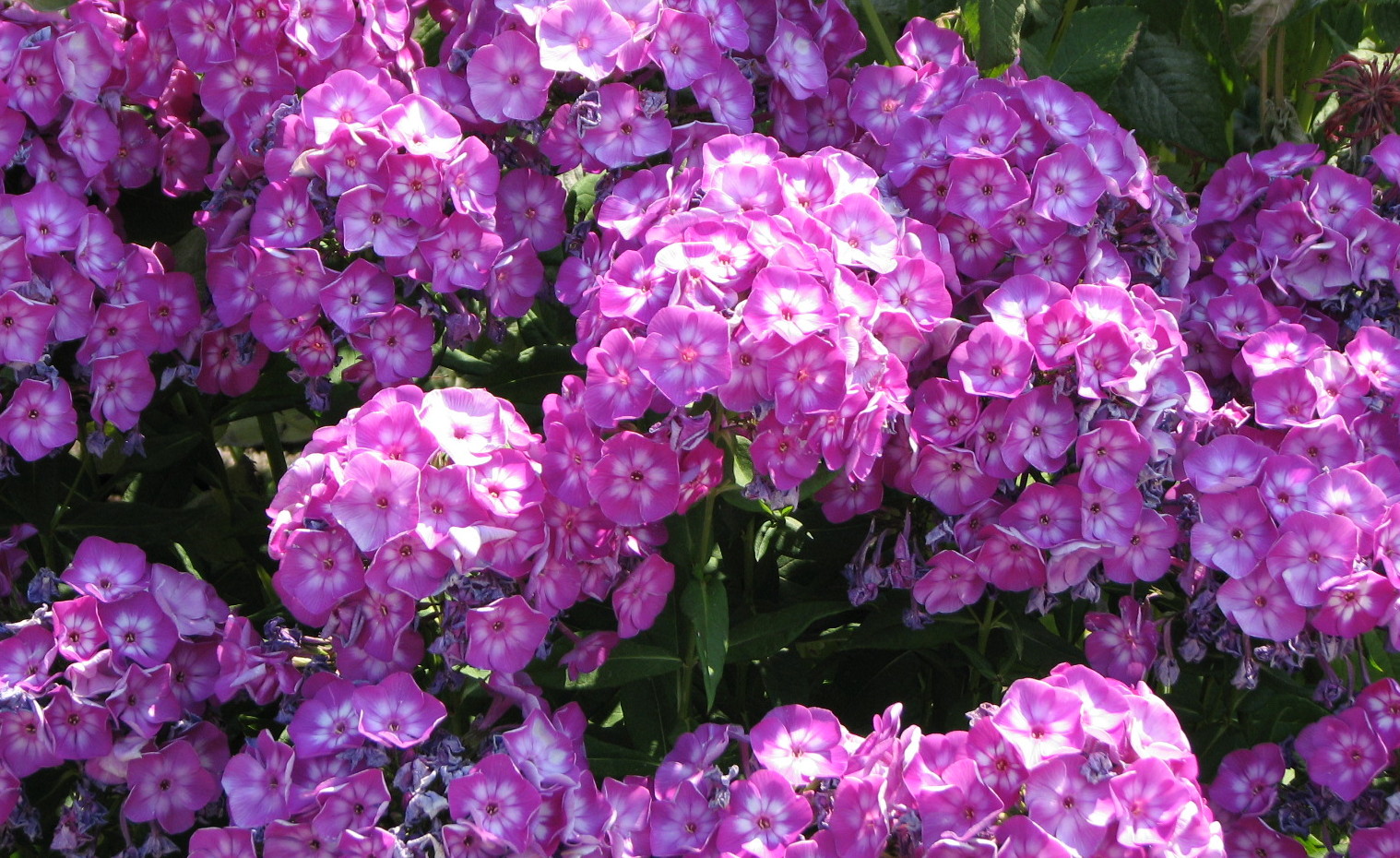
I share with you some photos of flowers that grow at this time of the year in Eastern Oregon. Some of them may be familiar to you, but others may not. These were taken over the past few weeks in different places, in front of houses, in yards, when I notice unusual or unfamiliar flowers, and record them on camera. 

An unusual double-growth on a pink daisy-like flower
Cleome
The growing season here is very short, and flowers usually bloom between June and August. Vegetables also are abundant at this time, but as soon as frost starts, usually by early September, everyone will be running to pick their tomatoes, zucchinis, string beans and other veggies they grow.


Sunday, August 12, 2012

Marathon Day

Marathon winner Stephen Kiprotich in the middle, flanked by two Kenyans
As the Olympic Games end today in London, traditionally the last day is also Marathon Day when the men’s marathon was run through the historic and picturesque streets of London. The winner was Stephen Kiprotich of Uganda, followed by two Kenyans. It was impressive to see the winner kneeling down on the finish line, kissing his country’s flag and then blessing himself. 

Meseret Defar of Ethiopia with picture of the Blessed Mother
Two days earlier, another female athlete, Meseret Defar of Ethiopia became ecstatic after winning the 5000 meters, and also knelt down and took a picture of the Blessed Mother from under her shirt, kissing it and showing it to the camera. There was also the impressive story of David Rudisha, who won the 800 meters in a world record time, after coming from the Masai tribe in Kenya, and not having any facilities to train in. However he was noticed by a lay missionary Patrician brother Colm O’Connell who trained him on dirt roads, creating a sort of a track after removing stones and covering holes on the road. David was also encouraged to start running after seeing his father’s silver medal form the 1968 Olympics which he had won in a relay race for Kenya. There are many other touching stories that connect faith and sport. The spirit of the Olympics reigns supreme, higher, stronger and faster.

Saturday, August 11, 2012

Saint Clare


Clare was a beautiful Italian noblewoman who became the Foundress of an order of nuns now called "Poor Clares." When she heard St. Francis of Assisi preach, her heart burned with a great desire to imitate Francis and to live a poor humble life for Jesus. So one evening, she ran away from home, and in a little chapel outside Assisi, gave herself to God. St. Francis cut off her hair and gave her a rough brown habit to wear, tied with a plain cord around her waist. Her parents tried in every way to make her return home, but Clare would not.
Soon her sister Agnes joined her, as well as other young women who wanted to be brides of Jesus, and live without any money. St. Clare and her sisters wore no shoes, ate no meat, lived in a poor house, and kept silent most of the time. Yet they were very happy, because Our Lord was close to them all the time. Once, He saved them from a great danger in answer to St. Clare's prayer. An army of rough soldiers came to attack Assisi and they planned to raid the convent first. Although very sick, St. Clare had herself carried to the wall and right there, where the enemies could see it, she had the Blessed Sacrament placed. Then on her knees, she begged God to save the Sisters. "O Lord, protect these Sisters whom I cannot protect now," she prayed. A voice seemed to answer: "I will keep them always in My care."
At the same time a sudden fright struck the attackers and they fled as fast as they could. St. Clare was sick and suffered great pains for many years, but she said that no pain could trouble her. So great was her joy in serving the Lord that she once exclaimed: "They say that we are too poor, but can a heart which possesses the infinite God be truly called poor?"                                    
Many stories and allegorical tales have been created with St Francis and St Clare, including the popular movie and phrase “Brother Sun, Sister Moon.” But the fact is that both St Clare and St Francis laid a foundation for what to become one of the most influential orders of priests, friars and sisters, the Franciscans. Many other Orders splintered from the original Franciscans, but the foundation of each group remained always a life of poverty and good Christian example, a life detached from the materialism of this world.

The Poor Clares at St Julian's Monastery, Malta
In my hometown of St Julian’s, Malta, there is a monastery of cloistered nuns, St Clare’s Monastery and they have had the respect and admiration of everyone who gets to know them. I’ve served and said many Masses in their chapel, they crafted my priestly chasubles, and other vestments and have been close to my family, in prayer and support that both of us needed. This is what they say on their website: “We are an enclosed contemplative fraternity of Poor Clare sisters whose monastery is in Regional Road, St Julian’s. Our life is centered on daily prolonged silent prayer, the celebration of the Holy Eucharist and Adoration of the Blessed Sacrament. As contemplatives we dedicate more time to praise of God. Our deep spiritual life enables us to enter deeply into silent conversation with Him. Meditation on the Scripture, as well as other spiritual reading, provides the foundation for this prayer.”

Friday, August 10, 2012

Saint Lawrence

"St Lawrence helping the poor" by Fra Angelico

Saint Lawrence was one of seven deacons in Rome who were in charge of giving help to the poor and the needy. When a persecution broke out, Pope St. Sixtus was condemned to death. As he was led to execution, Lawrence followed him weeping, "Father, where are you going without your deacon?" he said. "I am not leaving you, my son," answered the Pope. "in three days you will follow me." Full of joy, Lawrence gave to the poor the rest of the money he had on hand and even sold expensive vessels, chalices and candlesticks to have more to give away.
The Prefect of Rome, a greedy pagan, thought the Church had a great fortune hidden away. So he ordered Lawrence to bring the Church's treasure to him. The Saint said he would, in three days. Then he went through the city and gathered together all the poor and sick people supported by the Church and lined them all up. When he showed them to the Prefect, he said: "This is the Church's treasure!"  
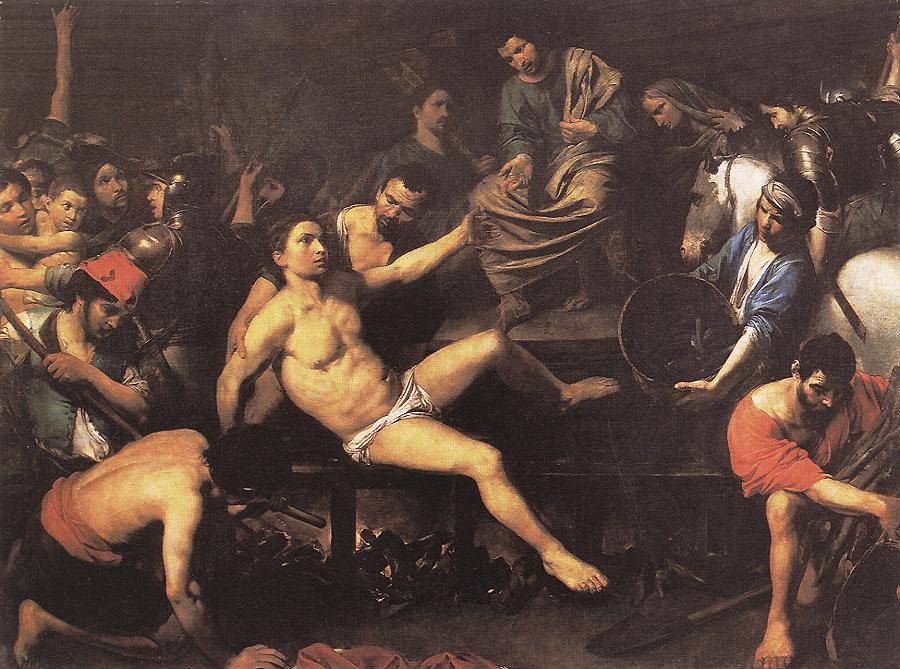
"Martyrdom of St Lawrence" by Valentin-de-Boulogne

In great anger, the Prefect condemned Lawrence to a slow, cruel death. The Saint was tied on top of an iron grill over a slow fire that roasted his flesh little by little, but Lawrence was burning with so much love of God that he almost did not feel the flames. In fact, he even joked, "Turn me over," he said to the judge. "I'm done on this side!" And just before he died, he said, "It's cooked enough now." Then he prayed that the city of Rome might be converted to Jesus and that the Catholic faith might spread all over the world. After that, he went to receive the martyr's reward.
St Lawrence is one of thousands of martyrs who were mercilessly killed by the ruthless Emperors in the first 300 years of Christianity. Others were crucified, sent to the lions, beheaded, burned, tied to a tree and arrows shot at them, others were skinned or had parts of their body taken out or cut off. With St Stephen he is the patron saint of deacons.

Thursday, August 9, 2012

St Teresa Benedicta of the Cross


St Teresa Benedicta of the Cross  was a German-Jewish philosopher, nun, a martyr and a highly unusual saint of the Catholic Church. Born into an observant Jewish family in Breslau, a German province of Prussia on October 12, 1891, she was named Edith and her family name was Stein. Edith was a very gifted child who enjoyed learning. She greatly admired her mother's strong faith; however, by her teenage years Stein had become an atheist.  In 1916, she received a doctorate of philosophy from the University of Göttingen, and soon afterwards became a member of the faculty in Freiburg.

As Edith Stein, just before her conversion to the Catholic faith
While Stein had earlier contacts with Catholicism, it was her reading of the autobiography of the mystic St. Teresa of Ávila on a holiday in Göttingen in 1921 that caused her conversion. She was eventually baptized on January 1, 1922, gave up her job at Freiburg and started to teach at a Dominican girls' school in Speyer from 1922 to 1932.
In a letter to Pope Pius XI, she denounced the Nazi regime and asked the Pope to openly denounce the regime "to put a stop to this abuse of Christ's name.” Although she never received an answer, in 1937, Pope Pius XI issued an encyclical written in German, "Mit brennender Sorge," in which he criticized Nazism, and condemned anti-semitism. I’m sure her letter had some influence on this.
St Teresa at Auschwitz concentration camp
She entered the Discalced Carmelite monastery Our Lady of Peace at Cologne in 1933 and took the name Teresa Benedicta of the Cross.  Although she moved from Germany to the Netherlands to avoid Nazi persecution, in 1942 she was not safe there. The Dutch Bishops had a public statement read in all the churches of the country in July 1942, condemning Nazi racism. In a retaliatory response a few weeks later, the Reichskomissar ordered the arrest of all Jewish converts, who had previously been spared. Sr. Teresa Benedicta and her sister Rosa, also a convert, were captured and shipped to the Auschwitz concentration camp, where they were gassed on August 9, 1942 when Edith was only 50. Edith Stein was canonized as Saint Teresa Benedicta of the Cross by Pope John Paul II in 1998; however, she is also often referred to as "Saint Edith Stein".

Wednesday, August 8, 2012

Saint Dominic

Along with the Franciscans and the Jesuits, the Dominicans are probably the most popular religious order, both for men and women, priests, brothers and nuns. The son of Felix Guzman and Bl. Joan of Aza, Dominic was born at Calaruega, Spain. The story is told that before his birth his mother dreamed that a dog leapt from her womb carrying a torch in its mouth, and "seemed to set the earth on fire". That is why in many of the statues of St Dominic, a dog carrying a torch is placed near his feet.
He studied at the University at Palencia , was probably ordained there while pursuing his studies and was appointed canon at Osma in 1199. There he became prior superior of the chapter, which was noted for its strict adherence to the rule of St. Benedict. In 1203 he accompanied Bishop Diego de Avezedo to Languedoc where Dominic preached against the Albigensian heresy and helped reform the Cistercians. When papal legate Peter of Castelnan was murdered by the Albigensians in 1208, Pope Innocent III launched a crusade against them headed by Count Simon IV of Montfort which was to continue for the next seven years. Dominic followed the army and preached to the heretics but with no great success. In 1214 Simon gave him a castle at Casseneuil and Dominic with six followers founded an order devoted to the conversion of the Albigensians; the order was canonically approved by the bishop of Toulouse the following year. He failed to gain approval for his order of preachers at the fourth General Council of the Lateran in 1215 but received Pope Honorius III's approval in the following year, and the Order of Preachers (the Dominicans) was founded.

Guido Reni painting of St Dominic in a church in Bologna, Italy
Dominic spent the last years of this life organizing the order, traveling all over Italy, Spain and France preaching and attracting new members and establishing new houses. The new order was phenomenally successful in conversion work as it applied Dominic's concept of harmonizing the intellectual life with popular needs. He convoked the first general council of the order at Bologna in 1220 and died there the following year on August 6, after being forced by illness to return from a preaching tour in Hungary. He was canonized in 1234. Dominicans today number 6,500, not counting many nuns who work as teachers, in social work and in hospitals.

Tuesday, August 7, 2012

A Dog's Plea

Treat me kindly, my beloved friend, for no heart in all the world is more grateful for kindness than the loving heart of me.
Do not break my spirit with a stick, for though I might lick your hand between blows, your patience and understanding will more quickly teach me the things you would have me learn.
Speak to me often, for your voice is the world’s sweetest music, as you must know by the fierce wagging of my tail when the sound of your footsteps falls upon my waiting ear.
Please take me inside when it is cold and wet, for I am a domesticated animal, no longer accustomed to bitter elements. 
I ask no greater glory than the privilege to sit at your feet beside the hearth.
Keep my pan filled with fresh water, for I cannot tell you when I suffer thirst.

Feed me clean food that I may stay well, to romp and play and do your bidding, to walk by your side and stand ready, willing and able to protect you with my life, should your life be in danger.
And, my friend, when I am very old and I no longer enjoy good health, hearing and sight, do not make heroic efforts to keep me going. I am not having any fun.
Please see to it that my life is taken gently. I shall leave this earth knowing with the last breath I draw that my fate was always safest in your hands.

Monday, August 6, 2012

Transfiguration

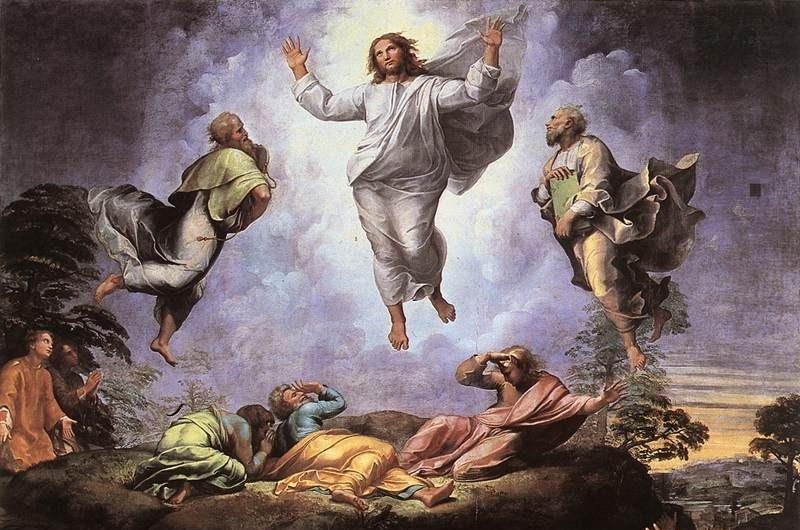
Raphael - The Transfiguration
Jesus took Peter, James and his brother John and led them up a high mountain apart by themselves. And he was transfigured before them, and his clothes became dazzling white, such as no fuller on  earth could bleach them. Then Elijah appeared to them along with Moses, and they were conversing with Jesus. Then a cloud came, casting a shadow over them; from the cloud came a voice: "This is my beloved Son. Listen to Him."

Are we listening to Him? He still talks to us through Scripture, through miracles that still happen daily, through the Eucharist, through recommendations we receive from the Pope, our Bishops and priests. Are we listening to them? Because if we don't listen to them, we're not listening to Him!

Sunday, August 5, 2012

Heavenly Lake

"Heavenly Lake"

I offer you today one of my most recent water color paintings, which I named “Heavenly Lake.” This was done on very good quality paper, precisely 300 lb. Please click once on the painting to get a larger image of it. More paintings will be posted over the next few weeks. A section of it also presently seen in the heading for this blog, which I will change periodically.

Saturday, August 4, 2012

St John Baptist Vianney

My all-time favorite Saint is not just the patron saint of priests, but also the patron saint of all those who find learning and going to school tough and hard. The Cure of Ars’ life is itself a miracle. Jean-Marie Vianney was born on May 8, 1786, in the French town of Dardilly and was baptized the same day. His parents had six children of which Jean-Marie was the third. He grew up on his family's farm in a very devotional environment. His parents frequently helped the poor and gave hospitality to many pilgrims
By 1790, the French Revolution forced many loyal priests to hide from the government in order to carry out the sacraments in their parish. The Vianneys continued attending Mass, even though it was illegal. In order to attend Mass, they traveled to distant farms where they would pray in secret. Since the priests would risk their lives day by day, Jean-Marie began to look upon priests as heroes. During the Mass, the windows were covered so that the light of the candles could not be seen from the outside.
By 1802, peace was re-established, and Jean-Marie wanted to start studying, but he still had to serve in the army. He was 19 when he started school, while his classmates were all 11 or 12, but he persevered, even though he found the study of Latin very hard. He gave up many times, but he was eventually ordained a priest on August 13, 1815. He was sent as Assistant to his sponsor, Father Balley in the parish at Ecully. Three years later he was made parish priest of Ars, a remote French hamlet, where his reputation as a confessor and director of souls made him known throughout the Christian world.

The body of the Cure of Ars, in the Basilica of Ars, France

His life was one of extreme mortification. Accustomed to the most severe austerities, beleaguered by swarms of penitents, and besieged by the devil, this great mystic manifested tremendous patience. He was a wonder worker loved by the crowds, but he retained a childlike simplicity, and he remains to this day the living image of the priest after the heart of Christ.
He heard confessions of people from all over the world for 16 hours each day. His life was filled with works of charity and love. It is recorded that even the staunchest of sinners were converted at his mere word. He died August 4, 1859, and was canonized May 31, 1925.

Friday, August 3, 2012

Meeting the Berries

The Berry Family - click once to enlarge
As you can read from the list of my favorites further down, one of my favorite food items are strawberries. Unfortunately their season is pretty brief, but I remember picking them in New York and splurging on them. They are becoming quite popular in Malta too, although growing up, they were very rarely found. Well today I’d like you meet the rest of the berry family, and since I love everything that ends with the word -berry, this is one of my favorite photos. One of our parishioners, Mike Skidmore came over to the office yesterday and presented me with a variety of berries that grow in his garden. Needless to say I was smiling from ear to ear when I saw this collection of the berry family, and I quickly positioned them with a name tag for each group, and took this photo, which is easy to understand.

Listed in the photo are: strawberries, blueberries, green gooseberries, pixwell gooseberries, black currants, red currants, josta berries, loganberries, red raspberries, jewel black raspberries, crandall black currants, royal purple raspberries. Other berries are cranberries, mulberries, elderberries, bearberries, barberries, boysenberries and nannyberries. Enjoy them while they last.

Thursday, August 2, 2012

St Peter Julian Eymard

Born in France in February 1811, Peter Julian Eymard worked at his father's trade as cutler until eighteen when he went to the seminary at Grenoble. In spite of his poor health, he was ordained a priest in 1834. He served as a parish priest for several years, then in 1845 he joined the Marists where he worked as a well-respected spiritual advisor with seminarians and priests. He worked with  other lay organizations promoting devotion to the Blessed Virgin Mary and to the Eucharist. He rose to the position of Provincial of the Marist Society at Lyon in 1845. In 1856, due to disputes with the Marists, Eymard left them and founded the Congregation of the Blessed Sacrament and 2 years later founded the Servants of the Blessed Sacrament, a congregation for women.
The Congregation of the Blessed Sacrament began working with children in Paris to prepare them to receive their First Communion, even though this custom was only approved in 1909 by Pope Pius X. It also reached out to non-practicing Catholics, inviting them to repent and begin receiving Communion again. Eymard was a tireless proponent of frequent Holy Communion, another idea approved by Pope Pius X in 1905. 


Eymard overcame a number of difficulties to reach his goals, including poverty in his family and in his community, his father's opposition to his only son’s desire to be a priest, years of serious illness and pain, and the difficulties of getting diocesan and papal approval for his new Order. Eymard was a contemporary and a friend of other saints including Peter Chanel, John Vianney and Marcellin Champagnat, the founder of the Marists.
The French sculptor Auguste Rodin received counsel from Eymard when Rodin entered the Congregation as a lay brother in 1862, having giving up art after the death of his sister. Eymard recognized Rodin's talent and advised him to return to his vocation. Rodin later produced a bust of Eymard.
St. Peter Julian died on 1 August 1868. He was beatified in 1925, and canonized by Pope John XXIII on 9 December 1962. His Order runs a church in New York City where they have perpetual adoration of the Eucharist.

Wednesday, August 1, 2012

St Alphonsus Liguori


Saint Alphonsus Liguori was born in 1696 in Marianella, in the Kingdom of Naples, the first born of seven belonging to the Neapolitan nobility. Liguori went to law school at age sixteen, becoming a very well-known lawyer. He was thinking of leaving the profession, when at age 27, after having lost an important case, he made up a resolution to leave the profession of lawyer. He wrote to someone, “Our profession is too full of difficulties and dangers; we lead an unhappy life and run the risk of dying an unhappy death. For myself, I will quit this career.”
In 1723, after a long process of discernment, he abandoned his legal career and, despite his father's strong opposition, began his seminary studies in preparation for the priesthood in the Oratory of St Philip Neri. He was ordained a priest in 1726, at the age of 30. He lived his first years as a priest with the homeless and marginalized youth of Naples. He founded the "Evening Chapels". Run by the young people themselves, these chapels were centers of prayer, education, community, and social activities. At the time of his death, there were 72 of these chapels with over 10,000 active participants. His sermons were very effective at converting sinners. He had a special closeness to the much poorer and abandoned street children in Naples, known as scugnizzi. 

In 1732 Alphonsus founded the Congregation of the Most Holy Redeemer, (Redemptorists) when a nun named Sister Maria Celeste Castarosa told him that it was revealed to her that he was the one God have chosen to create the Congregation. This order's goal was to teach and preach in the slums of cities and other poor places. They also fought Jansenism, a heresy prevalent at his time. He gave himself entirely to this new mission. Sister Castarosa later founded the Redemptorist order of Nuns.
Alphonsus was consecrated bishop of the diocese of Sant' Agata dei Goti in 1762. He tried to refuse the appointment because he felt too old and too sick to properly care for the diocese. During this time he wrote sermons, books, and articles to encourage the devotion of the Blessed Sacrament and the Blessed Virgin Mary. In 1775 he was allowed to retire from his office and went to live in the Redemptorist community in Pagani, Italy where he died on August 1, 1787. He was canonized in 1831 by Pope Gregory XVI, proclaimed a Doctor of the Church in 1871 by Pope Pius IX. He was named Patron of Confessors and Moralists by Pope Pius XII in 1950, who also wrote an encyclical on him. Redemptorists today number over 5,800 world-wide.